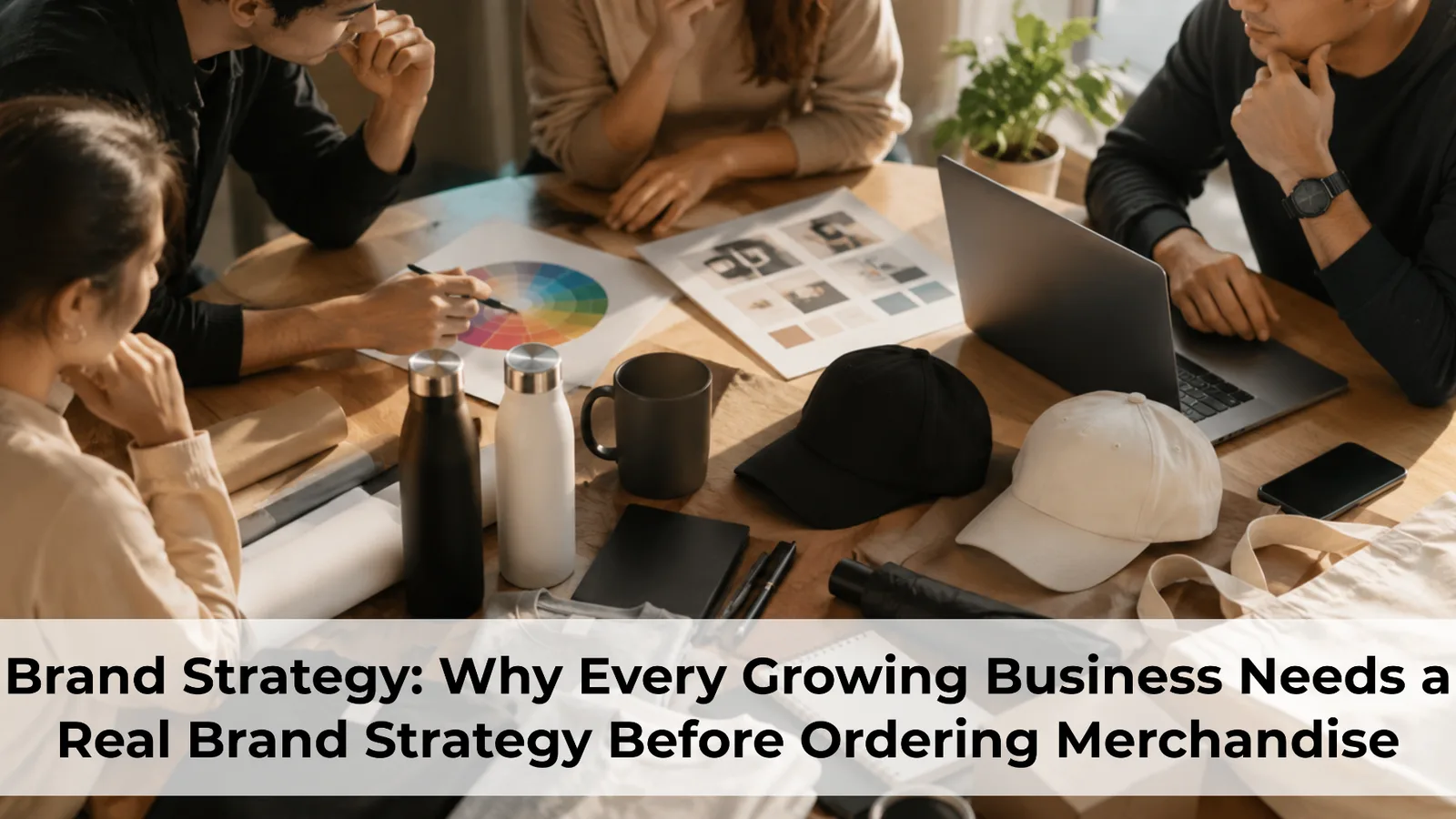
There's a familiar sequence in fast-growing companies: revenue is climbing, headcount is growing, and someone on the marketing or HR team is tasked with ordering branded T-shirts, notebooks, or welcome kits for the next batch of new hires or the next trade show. The logo file gets pulled from a shared drive, a few colours get chosen, and an order goes out. It feels productive. It's also, more often than not, a missed opportunity and sometimes an active mistake. The problem isn't the merchandise. It's that merchandise decisions are being made without any strategic foundation underneath them, which means every item ordered is a guess dressed up as a decision.
Merchandise Without Strategy Is Just Spending
A T-shirt with a logo on it isn't inherently valuable. What makes merchandise valuable is what it represents, whether it reflects a brand's actual positioning, whether it's something the recipient will genuinely want to keep and use, and whether it reinforces the same impression the company is trying to build everywhere else. None of that can be figured out at the point of placing an order. It has to be decided beforehand, deliberately, as part of a broader brand strategy. Without that foundation, merchandise decisions get made on gut feel "this design looks nice," "this colour matches our website" which might produce something visually fine but strategically empty. It won't be wrong exactly. It just won't be doing any real work for the brand.
What a Brand Strategy Actually Establishes
A brand strategy isn't a logo, a colour palette, or a tagline. It's the underlying set of decisions about who the brand is for, what it stands for, and how it wants to be perceived decisions that then inform every downstream choice, including merchandise.
Concretely, a solid brand strategy should answer:
- Who is this brand actually trying to reach, and what do those people value? A brand appealing to enterprise buyers needs a very different tone and very different merchandise than one targeting early-stage startups.
- What does the brand promise, and how should that promise show up physically? A brand built on reliability and precision should feel different, in every touchpoint including merchandise, than one built on creativity and energy.
- What's the appropriate level of polish and formality? A conservative financial services brand and a fast-moving consumer tech brand shouldn't be ordering the same kind of welcome kit, even if their budgets are identical.
Once these questions have real answers, merchandise stops being a guess. A design brief for a new hire kit or an event giveaway can be checked against the strategy directly. Does this feel like the brand we said we wanted to be, or does it just look nice in isolation?
The Cost of Skipping This Step
Growing businesses that skip brand strategy and go straight to merchandise tend to accumulate a slow, quiet cost. Different departments end up ordering different versions of "on-brand" items, because nobody defines what on-brand actually means beyond a logo file. A trade show booth looks different in tone from the company website. An onboarding kit doesn't match the energy of the recruiting materials that got the new hire excited about the job in the first place. None of these inconsistencies are dramatic on their own. Collectively, they erode the sense that a company knows exactly who it is, which is precisely the impression strong brands work hardest to build.
Strategy First Doesn't Mean Slower
A common objection to doing brand strategy work before merchandise is time: a growing business needs onboarding kits now, not after a multi-week strategy engagement. This is a false trade-off. Brand strategy doesn't need to be exhaustive to be useful. Even a focused, workshop-based process clarifying audience, tone, and a few non-negotiable brand principles is enough to give every future merchandise decision a clear reference point, without holding up next week's order. The investment pays for itself quickly. Once a brand strategy exists, every future merchandise decision gets faster, not slower, because there's a clear standard to check against instead of starting from scratch each time.
Get the Foundation Right, Then Build
Ordering merchandise without a brand strategy isn't wrong in the sense of being disastrous it's wrong in the sense of being wasteful. Money gets spent, items get shipped, and the opportunity to have that spend actually reinforce the brand gets missed. For any growing business planning to order merchandise regularly onboarding kits, event swag, client gifts the smarter sequence is to define the brand first, even briefly, and let every merchandise decision that follows be a genuine expression of that strategy rather than a guess made under a deadline.
FAQs:
1. What exactly counts as "brand strategy," and how is it different from a logo or colour palette? Brand strategy is the underlying set of decisions about who a brand is for, what it stands for, and how it wants to be perceived. A logo and colour palette are visual expressions of that strategy, not the strategy itself. Two brands can have similarly polished logos and completely different strategic foundations one built around reliability and precision, another around creativity and energy and that difference should shape everything from messaging to merchandise. 2. Can a small or early-stage business really afford to do brand strategy work? Brand strategy doesn't have to mean an expensive, months-long engagement. Even a focused, workshop-based process addressing audience, tone, and a few core brand principles gives a business a real reference point for future decisions. The cost of skipping inconsistent materials, mismatched merchandise, a diluted first impression is often higher than the cost of a lean strategy exercise done early. 3. What actually goes wrong if a business orders merchandise without a defined brand strategy? Without a strategic foundation, merchandise decisions get made on gut feel rather than intention. Different departments end up producing materials that all look "on-brand" to them individually but don't add up to a consistent whole: a mismatch between a trade show booth, a company website, and an onboarding kit, for example. None of these issues are disastrous alone, but together they erode the sense that a company has a clear identity.
4. Does brand strategy work slow down time-sensitive merchandise orders?
It shouldn't, once the initial groundwork is done. In fact, having a defined strategy tends to speed up future decisions, because there's a clear standard to check new merchandise or campaign ideas against instead of debating from scratch each time. The slowdown people fear usually comes from treating strategy as a one-time blocker rather than a foundation that makes every future decision faster. 5. How do I know if my business's branding problem is strategic or just a design execution issue? If a business can clearly articulate who it serves and what it stands for, but its materials still look inconsistent across channels, the issue is usually execution, not strategy. If nobody in the business can confidently answer basic questions about audience and positioning, that points to a deeper strategic gap that needs addressing before design or merchandise decisions can be made with any real confidence. 6. What's the first practical step toward building a brand strategy before the next merchandise order? Start by getting the relevant stakeholders, founders, marketing leads, sometimes customer-facing teams into a structured conversation about who the brand is competing for attention with, what it promises, and where the current perception gap might be. The output doesn't need to be a lengthy document; even a short, clear set of principles is enough to give the next merchandise or design decision a genuine strategic anchor rather than a guess.
Most businesses approach branded merchandise the wrong way around. They pick a product, add a logo, place an order, and only later ask whether the result actually looks like something the company would stand behind. A genuine brand strategy reverses this sequence: it defines what the brand should look, feel, and sound like across every touchpoint first, so that every subsequent decision from a hoodie's stitching to a client gift's packaging flows from a clear, consistent plan rather than being improvised order by order. Saltycustoms builds this kind of agency-level strategy for clients expanding across Singapore, Malaysia, and the United States, where inconsistency between markets is one of the fastest ways to erode brand trust.
What a Brand Strategy Actually Covers
A proper brand strategy is not a mood board or a colour palette alone. It typically defines brand positioning relative to competitors, a consistent visual identity system, tone of voice guidelines, and for a merchandise-driven brand clear standards for how that identity translates into physical products across markets. Without this foundation, individual departments end up making disconnected decisions: marketing picks one shade of blue, HR orders onboarding kits in another, and a regional office adds a third variation entirely.
The Cost of Skipping Strategy
Businesses that skip straight to production without a strategic foundation typically discover the cost later, once merchandise, marketing materials, and client-facing collateral no longer look like they come from the same company. Correcting this after the fact, reprinting stock, redesigning packaging, retraining teams on updated guidelines is considerably more expensive than getting the strategy right at the outset. A clear corporate merchandise strategy avoids this rework entirely by establishing the rules once, upfront.
Why Cohesion Across Markets Is Especially Difficult
For businesses operating across Singapore, Malaysia, and the United States simultaneously, brand cohesion faces an additional challenge: different regional teams, different suppliers, and sometimes different agencies handling each market independently. Without a shared strategic document, it is common for the same company to look meaningfully different depending on which office ordered the merchandise. A unified brand strategy gives every regional team the same reference point, regardless of which local supplier ultimately produces the item.
Positioning as the Starting Point
Before any visual or product decision is made, a strategy needs a clear answer to a simpler question: what does this brand stand for, and how is that different from competitors in the same space? This positioning work shapes everything downstream. A brand positioned around premium craftsmanship will make very different merchandise decisions than one positioned around approachability and value. Skipping this step leads to merchandise that might look attractive in isolation but does not actually reinforce what the business is trying to communicate.
Translating Strategy into Physical Products
Once positioning and visual identity are defined, the real work of a merchandise-focused brand strategy is translating those abstract guidelines into concrete decisions: which materials align with a premium positioning, which colours and finishes should appear across every branded item, and which occasions call for a flagship-quality item versus a simpler everyday piece. This translation step is where many businesses struggle without dedicated strategic support, since it requires both brand fluency and practical knowledge of manufacturing and materials.
Building Guidelines That Teams Actually Use
A strategy document that sits unread in a shared drive delivers no value. Effective brand guidelines are built to be genuinely usable by the people making day-to-day merchandise decisions HR ordering onboarding kits, sales requesting client gifts, regional offices sourcing local event materials with clear, specific direction rather than abstract brand language that is difficult to apply practically.
Strategy as a Foundation for Scaling
Businesses expanding into new markets face a choice: build brand strategy once, early, and scale it consistently, or rebuild brand decisions from scratch in every new market they enter. The first approach is considerably more efficient and produces a more recognisable, trustworthy brand as the company grows. A strategy built with scaling in mind flexible enough to adapt to local preferences while remaining recognisably consistent saves significant time and cost as a business expands from one market into several.
How Strategy Supports Better Vendor Decisions
With a clear strategy in place, businesses are far better equipped to brief and evaluate merchandise suppliers, since they can point to specific standards for materials, colour accuracy, and finish rather than relying on vague verbal instructions. This clarity also makes it easier to compare quotes from different suppliers on a like-for-like basis, since the specification itself is already defined before any pricing conversation begins.
Why Agency-Level Planning Matters
Smaller, informal approaches to brand strategy, a single internal meeting, a loosely documented style guide often miss the depth needed to hold up across multiple markets and departments over time. Agency-level strategic planning brings a level of rigour, competitive research, and cross-market experience that is difficult to replicate internally, particularly for businesses without a dedicated in-house brand team. Saltycustoms approaches brand strategy this way, building programmes designed to hold together as a business grows across Singapore, Malaysia, and the USA.
Measuring Whether a Brand Strategy Is Working
The success of a brand strategy shows up gradually: merchandise and marketing materials that consistently look like they belong to the same company regardless of which market or department produced them, faster decision-making when new merchandise needs arise since guidelines already exist, and stronger recognition from clients and employees who encounter the brand across multiple touchpoints. These outcomes are harder to quantify than a single campaign's click-through rate, but they compound steadily as a business scales.
Getting Started with a Brand Strategy Engagement
Businesses considering a formal brand strategy engagement should expect the process to begin with research into current brand perception and competitive positioning, followed by the development of core positioning and visual identity guidelines, and finally translation of those guidelines into practical standards for merchandise, packaging, and other physical touchpoints. This structured approach ensures the resulting strategy is grounded in real market understanding rather than internal assumptions alone.
Budgeting for Strategy as a Long-Term Investment
Businesses sometimes hesitate at the upfront cost of a formal strategy engagement, comparing it unfavourably against the lower visible cost of simply ordering merchandise directly from a catalogue. This comparison misses the point: strategy is not an alternative line item to merchandise production, but a foundation that makes every future merchandise, marketing, and design decision faster, more consistent, and less prone to costly rework. Viewed over a multi-year horizon rather than a single order, the upfront investment in strategy typically pays for itself many times over.
Conclusion
Ordering merchandise without a strategic foundation almost always costs more in the long run than investing in a proper brand strategy upfront. For businesses growing across multiple markets, a clear, well-documented strategy is what keeps every branded touchpoint from a hoodie to a client gift box recognisably consistent, giving customers and employees the same coherent experience of the brand no matter where or how they encounter it.
Frequently Asked Questions
1. Why is brand strategy important before ordering merchandise?
A brand strategy ensures that merchandise reflects your company’s positioning, visual identity, tone, and values. It helps businesses avoid inconsistent designs and ensures every branded product supports the overall brand experience.
2. What should a brand strategy include for corporate merchandise?
A strong brand strategy can include brand positioning, visual identity guidelines, colours, typography, tone of voice, preferred materials, product standards, packaging guidelines, and rules for applying the brand across different merchandise categories. 3. How does brand strategy help businesses operating across multiple markets? A unified brand strategy gives teams in different locations a consistent framework for making branding and merchandise decisions. This helps businesses maintain brand recognition across markets such as Singapore, Malaysia, and the United States while still allowing room for local adaptation.
4. Can a brand strategy reduce merchandise costs?
Yes. A clear strategy can reduce costly mistakes, reprints, inconsistent designs, and unnecessary product changes. By defining requirements before production begins, businesses can make faster vendor decisions and create merchandise more efficiently.
Meta Title
Brand Strategy Before Merchandise: Why It Matters
Focus Keyword
brand strategy before merchandise
Meta Description
Discover why growing businesses need a clear brand strategy before ordering merchandise to build consistency, recognition, and stronger customer connections.
Word Excerpt
A strong brand strategy should come before merchandise. Discover how clear branding helps growing businesses create consistent, memorable, and purposeful merchandise.
Merchandise lands better when the strategy behind it is clear. That is the core of our brand strategy work.