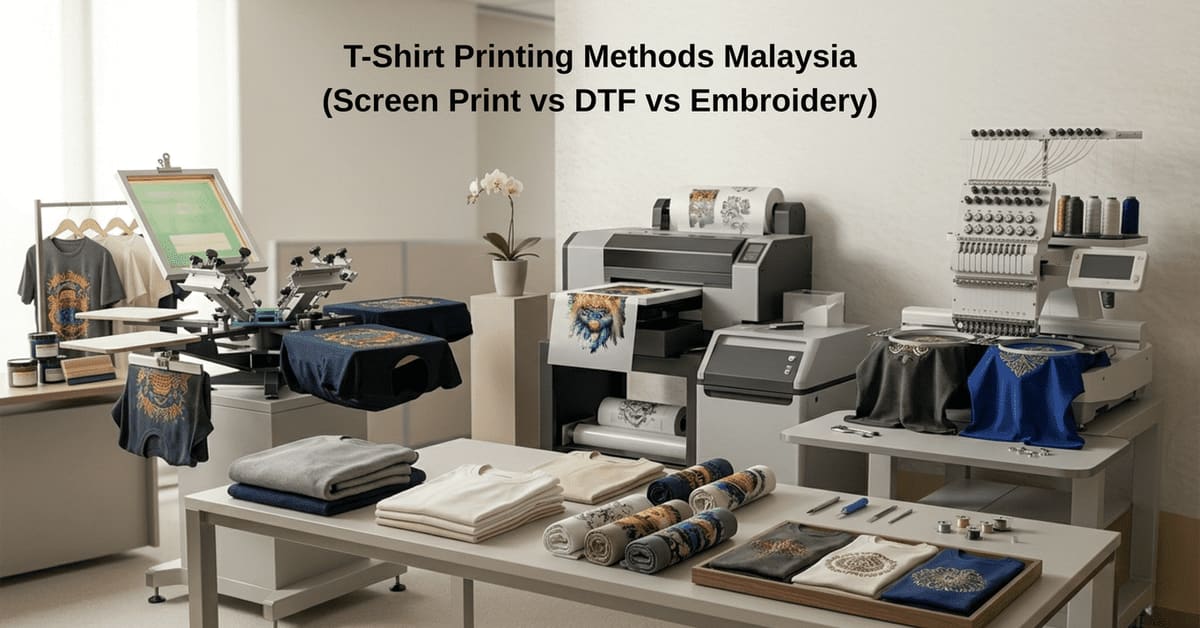
You have 200 corporate t-shirts to order. The design is approved, the deadline is real, and the budget has been signed off. What nobody mentioned is that there are four different ways to print that design each with its own cost structure, quality outcome, and lead time. Choose the wrong one and you will either overpay, underdeliver, or both.
This guide walks you through every major custom t-shirt printing method available in Malaysia, so you can match your order to the right technique before production begins, not after.
Why Print Method Matters More Than You Think
Most people treat the print method as a technical afterthought. It is not. It is one of the most consequential decisions in the entire merchandise process, and it affects four things directly.
Durability determines how long the print holds up under real-world conditions, repeated washing, daily wear, exposure to heat. A corporate polo shirt worn by a sales team every week needs to perform differently from an event tee worn once at a conference.
Colour accuracy affects whether your brand guidelines survive the production process. Some methods handle complex gradients and photographic artwork with ease. Others are designed for bold, flat colours and struggle with anything more intricate.
Cost per unit is never fixed; it shifts dramatically depending on the method and your order volume. The cheapest method at 50 units may be the most expensive at 300. Understanding this relationship prevents a great deal of wasted budget.
Minimum order implications matter because some techniques require volume to become cost-viable. Choosing a method that demands a 200-unit minimum when you only need 30 forces you into unnecessary overstock. The best print method for corporate merchandise is always the one that aligns with your actual quantity.
Screen Printing Malaysia How It Works, When to Use It
Screen printing is the oldest and most widely used method for custom t-shirt printing in Malaysia, and for good reason. Ink is pushed through a mesh stencil one screen per colour directly onto the fabric. The result is a vibrant, opaque print with excellent wash resistance.
Best for: Large quantities, bold designs, spot colours
Screen printing performs best when your order exceeds 100 units and your artwork uses between one and four solid colours. Corporate uniforms, event tees, team kits, and branded workwear are all natural fits. The setup cost which covers creating a separate screen for each colour is spread across the full order quantity, which is why the per-unit price drops sharply as volume increases. At 300 units with a two-colour logo, screen printing is typically the most cost-efficient option available.
Not ideal for: Small orders, photographic artwork, gradients
Where screen printing struggles is with complexity. Each additional colour in your design requires an additional screen, which adds both cost and setup time. Gradient artwork, watercolour-style illustrations, and photographic images are difficult or impossible to reproduce accurately. For orders below 80 units, the setup cost makes screen printing comparatively expensive relative to other methods.
Direct-to-Film (DTF) Printing The New Standard for Full Colour
DTF printing has changed the landscape of custom t-shirt printing in Malaysia considerably over the past few years. The process involves printing a design onto a specialised film, applying a powder adhesive, and then heat-pressing the finished transfer onto the fabric. Crucially, it requires no screens and no colour separation meaning there is no setup cost per colour.
Best for: Full-colour designs, small-to-medium quantities, personalisation
If your artwork is detailed, multi-coloured, or photographic, DTF is the right method. It handles gradients, fine lines, and complex illustrations without any compromise. It is also the preferred choice for personalized orders where individual names, numbers, or details vary across a batch because each item can be printed differently without additional cost. Orders between 10 and 150 units tend to be the sweet spot.
Cost comparison with screen printing
DTF carries a higher cost per unit than screen printing at large volumes. However, because there are no setup costs, it becomes more economical for smaller runs or colour-heavy designs where screen printing’s per-screen fees would add up. A common rule of thumb: for orders under 80–100 units with complex artwork, DTF will almost always work out cheaper. Above that threshold, screen printing typically takes over on cost.
One clarification worth making: modern DTF prints are wash-resistant and flexible. Early heat-applied transfers had a reputation for cracking and peeling, which has led some buyers to underestimate DTF. The technology has moved on significantly, and durability is no longer a concern with quality production.
Embroidery For When Only Premium Will Do
Embroidery is not a printing method in the ink-and-press sense, but it sits firmly within the same decision framework when you are choosing how to decorate a garment. Thread is stitched directly into the fabric using a digitised version of your logo or artwork. The result is raised, tactile, and unmistakably premium.
Best for: Polos, jackets, caps, and premium corporate gifting
When the brief is quality rather than quantity of colour, embroidery is the answer. It is the standard choice for polo shirts, corporate jackets, caps, and any garment going to senior stakeholders or clients in situations where the finish of the decoration signals something about the brand before the product is even used. It withstands heavy and frequent laundering far better than any print method, which makes it the right call for uniforms worn daily.
Setup costs and per-unit pricing explained
Embroidery involves a one-time digitisation fee, the process of converting your artwork into a stitch file. This is a fixed cost regardless of order size. Per-unit pricing is driven by stitch count: the larger or more complex the design, the more stitches, and therefore the higher the cost per garment. For straightforward logos and text, embroidery is cost-competitive from around 50 units upwards. It is not suited to designs with photographic detail or fine gradients, as the thread medium simply cannot reproduce that level of complexity.
Heat Transfer Vinyl (HTV) Quick, Simple, and Best Used Selectively
Heat transfer vinyl involves cutting a design from coloured vinyl film and heat-pressing it onto fabric. It is fast, requires no minimum order quantity, and works well for simple shapes, text, and names or numbers on sports kits. However, it is not the right choice for large corporate orders; per-unit cost is high at volume, and intricate designs do not translate well through vinyl cutting. It is most useful as a solution for one-off items or very small personalised runs.
The Decision Matrix Match Your Order to the Right Method
| Method | Best order size | Design complexity | Cost at scale | Finish quality |
| Screen Printing | 100+ units | Simple to medium | Lowest | Standard |
| DTF Printing | 10–150 units | Any complexity | Mid-range | Standard to good |
| Embroidery | 50–500 units | Low to medium | Mid-range | Premium |
| Heat Transfer Vinyl | 1–50 units | Simple only | Higher per unit | Standard |
To make this practical: if you are ordering 300 polo shirts for a regional sales conference, embroidery gives you the premium finish that the occasion requires. If you are ordering 60 tees with a full-colour illustrated design for a startup launch event, DTF is the right method. If you need 500 uniform t-shirts with a two-colour company logo, screen printing will deliver the best cost per unit by a meaningful margin.
What SaltyCustoms Recommends for Corporate Orders
After 14 years of managing custom t-shirt printing across Malaysia and the wider Southeast Asian region, the pattern in corporate orders is fairly consistent.
Screen printing is the default recommendation for large-scale uniform and event programmes where the design is clean and the volume justifies setup costs. It remains the most economical method at scale, and the print quality on bold artwork is difficult to beat.
DTF is the recommendation for anything with design complexity, full-colour campaign merchandise, onboarding kits with illustrated artwork, or any order that involves personalisation across the batch. It is also the more flexible option when lead times are tight, given the absence of screen setup.
Embroidery is the recommendation whenever the garment type or the recipient warrants a premium finish. Senior leadership gifting, client hospitality merchandise, and anything with a polo or outerwear silhouette should almost always go to embroidery over print.
That said, no two briefs are identical. The honest answer is that the right method depends on your specific design, quantity, garment type, and budget which is why SaltyCustoms assesses each project individually before making a recommendation. Browse our print methods gallery to see each technique executed across real projects, or explore ourfull product range to understand what each method looks like on different garment types.
If you are still weighing up options, our team is happy to advise at no cost and with no commitment required. Share your brief with us and we will tell you exactly which method makes sense, and why. Get in touch here, or take a look at the Gold Standard programme if you are planning a larger, end-to-end merchandise project.
If you measure merchandise like a channel, you will like how our performance marketing team thinks.