A common fear holds businesses back from addressing weak branding: the assumption that fixing it means starting over. New name, new logo, new website, new everything, a project big enough, expensive enough, and disruptive enough that it's easier to just live with visuals that aren't working. In most cases, this fear is misplaced. Weak branding rarely means a business needs to be rebuilt from zero. It usually means the existing brand has real equity that's being poorly expressed, not a brand that needs replacing.
Weak Visuals Usually Aren't a Strategy Problem
It's worth separating two different issues that often get bundled together: a brand that lacks a clear strategic position, and a brand that has a reasonably clear position but isn't expressing it well visually. The first is a deeper problem that does require strategic work. The second which is far more common is a design and execution problem, and it's fixable without touching the brand's underlying identity at all. Signs that the issue is execution rather than strategy: a company knows exactly what it does and who it's for, but its website, merchandise, and marketing materials all look like they were made by three different teams who never spoke to each other. The logo might be fine. The colours might even be fine individually. What's missing is a consistent system tying them together across every surface.
Auditing Before Rebuilding
The first step in fixing weak branding isn't design work, it's an honest audit. Pull together everything the brand currently produces: website pages, social content, merchandise, sales decks, event materials. Laid out side by side, inconsistencies usually become obvious quickly. Different shades of the same brand colour. Multiple typefaces used interchangeably. A logo that appears at three different sizes and proportions across different materials. This audit does two things. It identifies what's genuinely broken and needs fixing, and just as importantly it identifies what's already working and shouldn't be touched. Many brands have more usable equity than they realise: a distinctive colour, a recognisable shape or motif, a tone of voice that resonates with customers. A good fix builds on these elements rather than discarding them along with the parts that aren't working.
Fixing the System, Not Just the Assets
Once the audit is done, the fix usually isn't a single new logo or a single new website. It's building (or rebuilding) a lightweight visual system, a defined colour palette, consistent typography, clear rules for how the logo can and can't be used, and a consistent visual tone across photography, illustration, or graphic style. This system becomes the reference point every future asset gets checked against, which prevents the same fragmentation from creeping back in six months later. Importantly, this kind of fix can often happen in layers. A business doesn't need to redesign every existing asset overnight. New materials, the next merchandise order, the next campaign, the next set of sales materials can start following the corrected system immediately, while older materials get updated on their normal replacement cycle rather than all at once.
Where Merchandise Fits Into the Fix
Merchandise is often one of the fastest, most visible places to demonstrate a corrected visual system in action. A refreshed onboarding kit, a redesigned event booth, or a new round of client gifts gives a brand a concrete, tangible way to show what "fixed" actually looks like, often faster than a full website overhaul, and with immediate visibility to employees, clients, or event attendees. This is also where the temptation to over-correct needs to be managed. A brand fixing weak visuals shouldn't swing to the opposite extreme and produce something unrecognisable from what came before, especially if there's real customer or employee familiarity with the existing look. The goal is coherence and quality, not novelty for its own sake.
When a Full Rebrand Actually Is Necessary
None of this is to say full rebrands are never warranted. If an audit reveals the underlying strategy itself is unclear nobody can articulate who the brand is for or what it stands for; visual fixes alone won't solve the real problem. But this is a smaller subset of cases than most businesses assume. Far more often, the fix is disciplined design work: consistent application of an existing (or lightly refined) brand across every surface, rather than reinventing the brand's foundation entirely. For most businesses with weak branding, the more accurate diagnosis isn't "our brand is broken." It's "our brand has never been applied consistently" and that's a problem solved with design discipline, not a fresh start.
FAQs:
1. How do I know if my business needs a full rebrand or just a design fix?
If your business can clearly explain who it's for and what it stands for, but its materials look inconsistent across channels, that's usually a design execution problem, not a strategic one fixable without touching the brand's core identity. A full rebrand is warranted only when the underlying strategy itself is unclear, which is a smaller subset of cases than most businesses assume.
2. What's the first step in fixing weak branding?
Start with an honest audit, not a redesign. Lay out everything the brand currently produces, website, social content, merchandise, sales materials side by side. Inconsistencies usually become obvious quickly: different shades of the same colour, inconsistent typefaces, a logo used at varying sizes and proportions. This audit reveals both what's broken and what's already working and worth preserving. 3. Will fixing our branding mean losing the visual elements customers already recognise? Not if the fix is done properly. A good branding fix builds on existing equity: a distinctive colour, a recognisable shape, a tone that already resonates rather than discarding it. The goal is coherence and consistency, not reinventing the brand from nothing. Businesses that over-correct and abandon familiar elements risk confusing the very customers they've already built recognition with.
4. Do we need to redesign everything at once?
No. Once a corrected visual system is defined, palette, typography, logo usage rules, and visual tone, new materials can start following it immediately, while older assets get updated on their normal replacement cycle. This layered approach avoids the cost and disruption of an all-at-once overhaul while still moving the brand toward consistency.
5. Where's a good place to visibly demonstrate a branding fix quickly?
Merchandise is often one of the fastest, most visible ways to show a corrected visual system in action. A refreshed onboarding kit, event booth, or client gift makes the improvement tangible to employees and clients quickly, often faster than a full website overhaul, while the rest of the brand's materials catch up over time.
6. How do we avoid making the same branding mistakes again after the fix?
Document the corrected system clearly colours, typography, logo usage, visual tone and use it as the standard every future asset gets checked against. Fragmentation usually creeps back in when there's no shared reference point, not because anyone intended to go off-brand. A simple, accessible guideline is often enough to prevent the same drift from happening a second time.
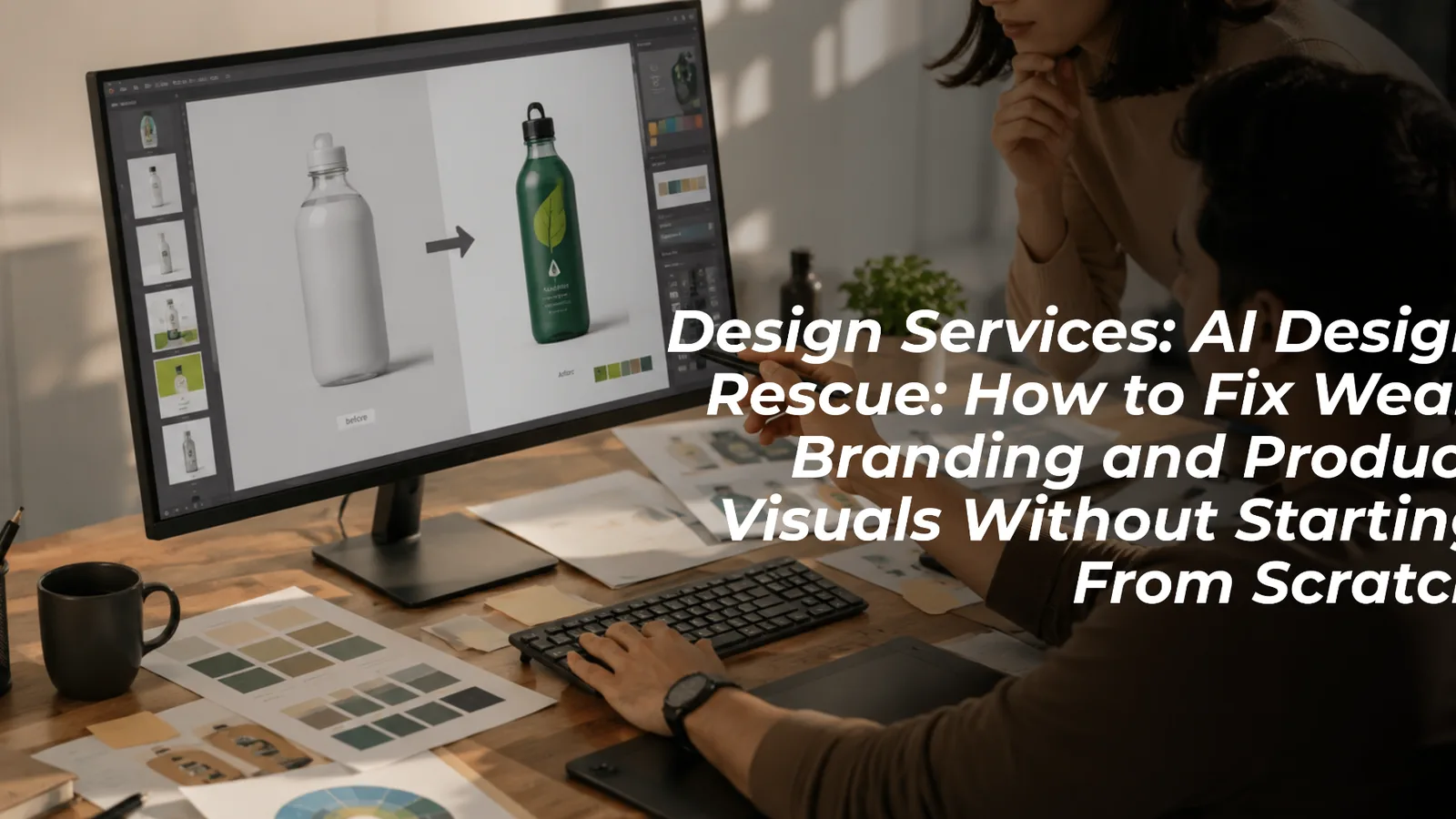
Many businesses are sitting on branded merchandise, product photography, or marketing visuals that almost work: a logo that looks slightly dated, product images with inconsistent lighting, packaging mockups that never quite matched the final printed result. Redoing all of this from zero is expensive and slow. AI design rescue offers a faster, more targeted alternative: using AI-assisted retouching and refinement tools to fix specific weaknesses in existing visual assets, rather than commissioning an entirely new design process for problems that may only need targeted correction.
What Design Rescue Actually Solves
Design rescue work typically addresses a specific, identifiable problem rather than a full rebrand. Common examples include correcting inconsistent colour across product photography taken in different lighting conditions, cleaning up low-resolution logos so they hold up on large-format print, adjusting a mockup so it accurately reflects how an item will look once produced, or refining a design that tested poorly with a target audience without discarding the underlying concept entirely.
Why AI-Assisted Retouching Changes the Economics
Traditional retouching and design correction work required considerable manual designer time for tasks like background removal, colour correction across large batches of images, or resizing and reformatting assets for different use cases. AI-assisted tools handle much of this repetitive, technical work considerably faster, which shifts designer time toward higher-value creative judgement rather than manual correction. For businesses with large catalogues of product images or merchandise mockups, this speed difference translates directly into lower cost and faster turnaround.
Common Scenarios Where Design Rescue Applies
Businesses most often turn to design rescue and retouch services when a merchandise catalogue has grown inconsistently over time, with images shot by different photographers under different conditions; when a rebrand has been partially rolled out but older assets have not yet been updated; when marketing materials need to be resized and reformatted across many different platforms and specifications; or when a design that performed well conceptually needs refinement based on feedback rather than a full restart.
The Difference Between Rescue Work and a Full Redesign
It is worth being clear-eyed about what design rescue is not: it is not a substitute for a genuine rebrand when the underlying identity itself is the problem. If a logo or visual system fundamentally does not reflect the brand's current positioning, no amount of retouching will fix that a full brand strategy and redesign process is the appropriate response. Design rescue is most effective when the underlying concept is sound but the execution needs correction, refinement, or consistency work.
Maintaining Brand Consistency Through Retouch Work
One of the more valuable applications of AI-assisted retouching is enforcing consistency across a large existing library of assets ensuring every product photo, every merchandise mockup, and every marketing image uses the same colour treatment, cropping standards, and finishing style. This kind of consistency work is tedious and error-prone when done manually across hundreds of images, but far more manageable with AI tools trained to apply a defined standard uniformly.
Preparing Assets for Print Versus Digital Use
Design rescue work also frequently involves preparing existing visual assets for uses they were not originally created for adapting a digital-only logo for large-format print, adjusting colour profiles between screen and print reproduction, or creating variations of an asset sized correctly for everything from a business card to a trade show banner. Businesses expanding their merchandise and marketing programmes often discover gaps like this only once a new use case arises, making rescue work a practical, ongoing need rather than a one-time project.
Working Efficiently with an AI-Enabled Design Partner
The efficiency gains from AI-assisted design work are most pronounced when paired with a partner who understands both the technical tools and the strategic brand context behind the work knowing which corrections serve the brand and which would compromise it. Saltycustoms applies AI-assisted design rescue and retouching within this broader strategic frame, ensuring speed gains do not come at the cost of brand consistency.
Setting Realistic Expectations for Turnaround and Cost
Because AI-assisted retouching genuinely does reduce manual labour on many repetitive tasks, businesses can reasonably expect faster turnaround and lower cost compared to traditional, fully manual design correction though complex judgement calls, particularly around brand fit and creative direction, still benefit from experienced human oversight rather than being left entirely to automated tools.
When to Choose Rescue Work Over Starting Fresh
A useful test for deciding between rescue work and a full redesign is asking whether the underlying concept still serves the brand's current positioning. If the answer is yes, and the problems are primarily technical or executional resolution, consistency, formatting rescue work is almost always the faster, more cost-effective path. If the underlying concept itself no longer fits, rescue work will only delay the more fundamental redesign the brand actually needs.
Auditing Existing Assets Before Starting Rescue Work
A useful first step in any design rescue engagement is a straightforward audit of existing visual assets cataloguing what exists, identifying where inconsistencies are most visible, and prioritising which corrections will have the greatest impact on how the brand is perceived. This audit prevents rescue work from becoming an unfocused, item-by-item exercise, and instead directs effort toward the assets that customers and prospects actually encounter most often, such as a homepage hero image or a bestselling merchandise item's product photography.
Combining Rescue Work with Broader Marketing Campaigns
Design rescue work often delivers the most value when timed alongside a broader marketing push, a product launch, a seasonal campaign, or a merchandise catalogue refresh since these moments already require refreshed visual assets and provide a natural checkpoint for correcting long-standing inconsistencies at the same time. Businesses that treat rescue work as an isolated, standalone task miss the efficiency of bundling it with work that is happening anyway.
Building a Sustainable Asset Library Going Forward
Beyond fixing existing problems, a design rescue engagement is a useful opportunity to establish clearer standards going forward defined colour profiles, consistent photography guidelines, and organised file management so that future assets do not accumulate the same inconsistencies that required correction this time around. This forward-looking element turns a one-time fix into a lasting improvement in how visual assets are produced and maintained.
Conclusion
AI design rescue and retouch work gives businesses a practical, faster alternative to a full redesign when the core problem is technical execution rather than fundamental brand fit. For companies with a growing library of merchandise mockups, product photography, and marketing visuals accumulated over time, this kind of targeted, AI-assisted correction restores consistency and quality without the cost and delay of starting the design process over from scratch.
Frequently Asked Questions
1. What is AI design rescue and retouching?
AI design rescue and retouching uses AI-assisted tools to improve existing visual assets without completely redesigning them. It can help correct colours, enhance image quality, remove backgrounds, refine layouts, and create consistent versions for different uses.
2. When should a business choose design rescue instead of a full redesign?
Design rescue is ideal when the underlying concept and brand identity are still relevant but the execution has issues such as poor image quality, inconsistent colours, outdated assets, or incorrect formatting. A full redesign is more appropriate when the overall brand identity no longer reflects the business.
3. Can AI retouching improve existing product photography?
Yes. AI-assisted retouching can help correct lighting and colours, remove unwanted backgrounds or elements, improve image consistency, and prepare product photos for different digital and print formats. Human creative oversight remains important for maintaining brand accuracy.
4. How can design rescue help reduce branding costs?
Instead of replacing every existing asset, businesses can focus on correcting the areas that need improvement most. This reduces unnecessary redesign work while helping extend the value of existing product images, merchandise mockups, logos, and marketing materials.
Meta Title
AI Design Rescue & Retouching for Better Brand Visuals
Focus Keyword
AI design rescue
Meta Description
Fix weak branding, product visuals, and marketing assets with AI design rescue and retouching. Improve consistency and quality without starting from scratch.
Word Excerpt
Discover how AI design rescue and retouching can improve existing branding, product photography, and marketing visuals without the cost of a complete redesign.
Need artwork for a run like this? Our design and artwork services get files production ready.