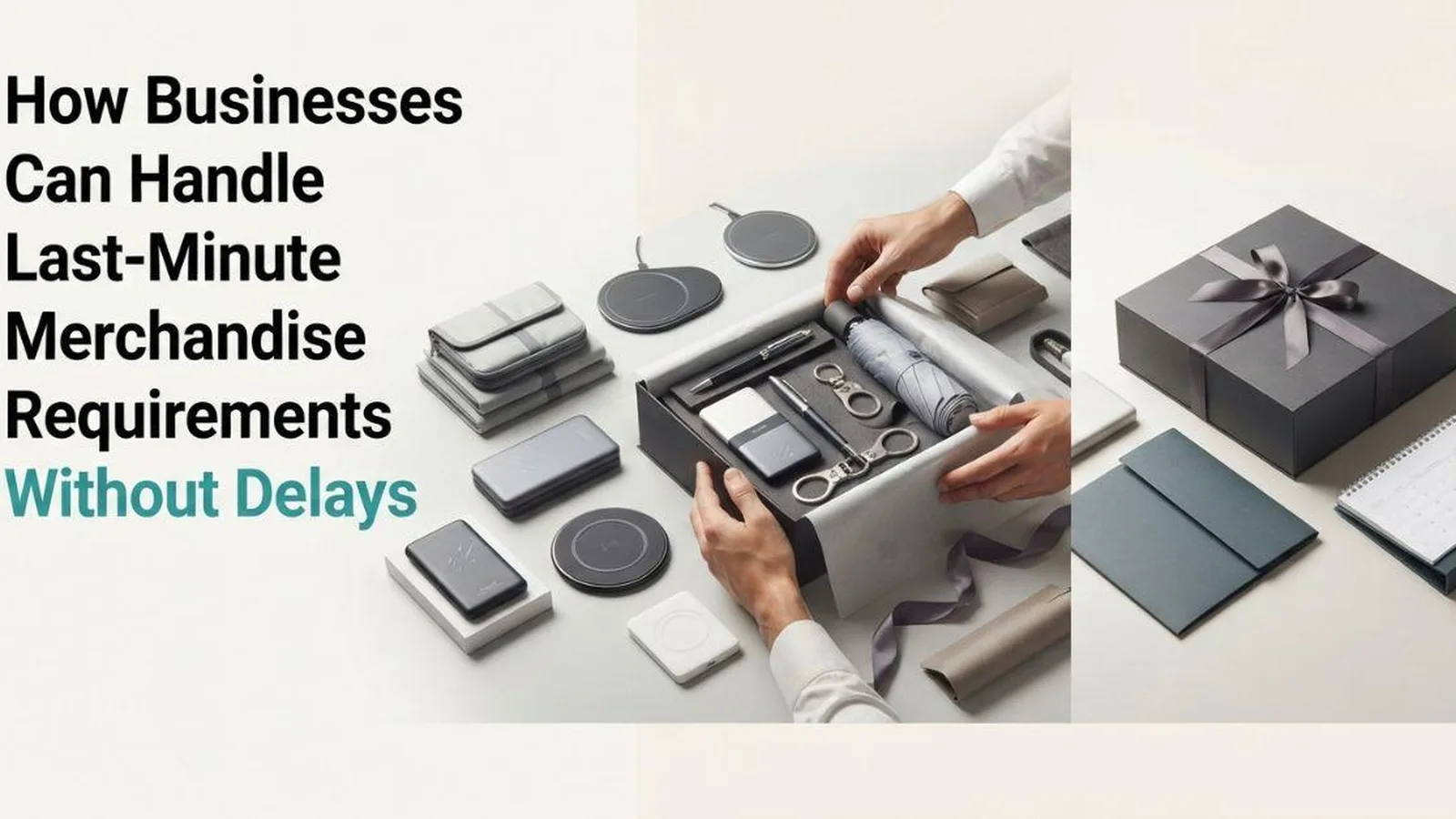
A client meeting gets confirmed for next week instead of next month. A new senior hire's start date moves up. A press opportunity lands with three days' notice instead of three weeks. In each of these situations, a business suddenly needs branded merchandise on a timeline that standard production was never designed to accommodate. Handling last-minute merchandise requirements well, rather than scrambling or settling for something generic, requires a different kind of preparation than planning for a scheduled annual order.
Why Last-Minute Needs Are Becoming More Common
Business cycles have compressed across most industries. Sales cycles close faster, press cycles move in days rather than weeks, and hiring decisions are made and acted on more quickly than in the past. This acceleration means merchandise needs that used to come with months of lead time now frequently arrive with only days of notice, and businesses without a plan for this reality are repeatedly caught off guard by the same kind of urgent request.
The Risk of Treating Every Urgent Request as a Crisis
Without a dedicated process for fast-turnaround needs, each urgent merchandise request tends to get handled as an emergency — a frantic search for any supplier who might be able to help, a compromise on quality just to meet the date, or in the worst case, missing the opportunity entirely because nothing could be arranged in time. This reactive pattern is exhausting for whoever manages merchandise internally and rarely produces results the business is proud to distribute.
What Actually Makes Fast Turnaround Possible
Genuine speed in merchandise production does not come from skipping steps; it comes from removing the steps that normally take the most time without removing quality control. Working from pre-approved materials and production methods with known, reliable timelines, rather than sourcing a new material or approving a new technique under pressure, is what allows a shorter overall timeline while still maintaining the checks that protect the final result.
Building an Approved Shortlist in Advance
One of the most practical steps a business can take is establishing a shortlist of pre-approved items, materials, and finishes before an urgent need ever arises. When a last-minute request comes in, choosing from this pre-vetted shortlist, already matched to brand guidelines, is considerably faster than starting a design and material selection process from scratch under time pressure.
Keeping Brand Files Ready to Go
A significant portion of the time lost in a rush order often has nothing to do with production itself — it is spent locating the correct logo file, confirming exact brand colours, or tracking down sizing information. Keeping these brand assets organised and readily accessible, ideally shared in advance with any merchandise partner a business works with regularly, removes this avoidable delay before an urgent order is even placed.
Setting Internal Expectations About What Is Realistic
Even the fastest production process has physical limits — materials need to arrive, printing and finishing take real time, and shipping has to happen. Internal stakeholders requesting urgent merchandise sometimes expect a turnaround that is simply not physically possible, and setting realistic expectations early, rather than promising an unrealistic timeline just to avoid a difficult conversation, prevents disappointment and rushed, lower-quality compromises later.
Matching the Order to What the Timeline Can Support
Fast turnaround works considerably better for smaller, more contained orders — a handful of client gifts, materials for a single event, an onboarding kit for a few new hires — than for very large distributions, which typically still require standard production timelines regardless of how efficient a process is. Recognising this distinction early helps set a realistic plan rather than attempting to compress an order that genuinely needs more time.
Why Consistency Should Never Be Sacrificed for Speed
A rushed order that does not match a business's usual brand standards can do more reputational harm than having no merchandise at all for the occasion. Even under significant time pressure, an urgent order should still follow existing brand guidelines for colour, logo usage, and material quality, so the result looks like a natural extension of the brand's usual work rather than a visibly hurried exception.
The True Cost of Missing an Urgent Deadline
It is worth weighing the cost of expedited production against the cost of missing the moment entirely — an empty merchandise table at a confirmed event, a new hire starting without an onboarding kit, a press opportunity passing without any branded materials on hand. In most cases, the modest premium for faster production is considerably cheaper than the lost opportunity of missing the deadline altogether.
Establishing a Relationship Before the Next Emergency
Businesses that face recurring last-minute merchandise needs benefit enormously from establishing a relationship with a capable partner before the next urgent request arrives, rather than searching for a new supplier under pressure each time. An established relationship means brand files, sizing information, and material preferences are already on record, meaningfully reducing the time needed for each subsequent urgent order.
How Saltycustoms Supports Urgent Timelines
Saltycustoms has built its fast-turnaround offering specifically around these realities, prioritising honest, achievable timelines and pre-vetted materials over unrealistic promises that risk a rushed or inconsistent outcome. For businesses that know urgent needs will eventually arise again, having this kind of dependable option in place removes much of the stress from the next unexpected request.
Building Internal Processes That Reduce Future Urgency
While some last-minute needs are genuinely unavoidable, businesses can reduce how often they occur by building better forecasting into their planning — tracking known upcoming events, anticipated hiring volume, and recurring client touchpoints further in advance. This does not eliminate every urgent request, but it does reduce the frequency with which merchandise decisions are made under genuine time pressure.
Choosing Items That Work Well Under Compressed Timelines
Not every merchandise category is equally suited to fast production. Items that rely on simple decoration methods, commonly stocked base products, and standard sizing generally move through production faster than items requiring specialised materials, custom moulds, or extensive finishing. Apparel with embroidered or printed logos, drinkware, notebooks, and tote bags typically fall into the faster category, while highly bespoke or multi-component items usually need standard lead times. Knowing this in advance helps a business choose items that genuinely fit an urgent timeline instead of discovering a mismatch halfway through an order.
Coordinating Approvals Quickly Without Losing Control
A surprising amount of delay in urgent orders comes from internal approval chains rather than production itself. A design proof waiting two days for a manager's sign-off can consume a large share of a short timeline. Businesses that expect urgent orders benefit from designating a single decision-maker with authority to approve proofs quickly, along with a clear checklist for what needs to be verified — logo placement, colour accuracy, spelling, and sizing — so that approval takes hours rather than days without sacrificing accuracy.
Managing Delivery Logistics for Time-Sensitive Orders
Production speed means little if delivery then adds unexpected days. For time-sensitive orders, it is worth confirming delivery method, destination address accuracy, and any customs or handling requirements before production even begins, particularly for cross-border shipments between markets such as Singapore and Malaysia. A clear logistics plan agreed upfront prevents a well-produced order from arriving late due to an avoidable shipping oversight.
Using Urgent Orders as a Chance to Test New Ideas
Smaller, faster orders can also serve as a low-risk way to test a new merchandise concept before committing to a larger production run. A small batch of a new item distributed at a short-notice event provides real feedback from actual recipients, which can then inform a more considered, larger-scale decision later, turning what began as an urgent need into useful market learning for the business.
Learning from Each Urgent Order to Improve the Next One
After each urgent order, a brief review of what slowed things down and what worked well builds a practical playbook for the next one. Over several cycles, this habit steadily shortens response times, since recurring bottlenecks such as missing brand files or slow approvals get identified and removed rather than repeated each time a new urgent request arrives.
Why Preparation Beats Improvisation Every Time
Teams that handle urgent merchandise well rarely do so through heroic last-minute effort. They do so because the groundwork was laid long before the request arrived: approved items, ready brand files, a trusted partner, and a clear internal approval path. Treating urgency as a predictable feature of modern business, rather than an unwelcome surprise, is what turns a stressful scramble into a routine, manageable process that still produces merchandise the business is proud to hand over.
Conclusion
Last-minute merchandise needs do not have to mean a choice between missing the opportunity or settling for something inconsistent with the rest of a brand's work. By building a pre-approved shortlist, keeping brand assets ready, setting realistic internal expectations, and establishing a relationship with a dependable fast-turnaround partner ahead of time, businesses can handle last-minute merchandise requirements with the same confidence and quality they bring to their planned, scheduled production.
Frequently Asked Questions
Q1. How fast can quality custom merchandise realistically be produced?
Turnaround depends on the item and quantity, but working with pre-approved materials and production methods generally allows for considerably faster delivery than a standard custom order, without skipping quality checks.
Q2. Does faster production always mean lower quality?
Not when the speed comes from efficient processes rather than skipped steps. Genuine fast-turnaround services maintain the same quality checks as standard production, just compressed through pre-vetted materials and prioritised capacity. Q3. What can a business do in advance to prepare for future urgent merchandise needs? Keeping brand files, approved colours, and sizing information organised and readily shareable, along with an established relationship with a merchandise partner, significantly reduces the time needed when an urgent request arises.
Q4. Is express merchandise production suitable for large orders?
Express timelines work best for smaller, more contained orders. Very large distributions generally still require standard production timelines, regardless of how efficient the process is.